Golf Simulator Low Ceiling Guide: What Works and What Does Not
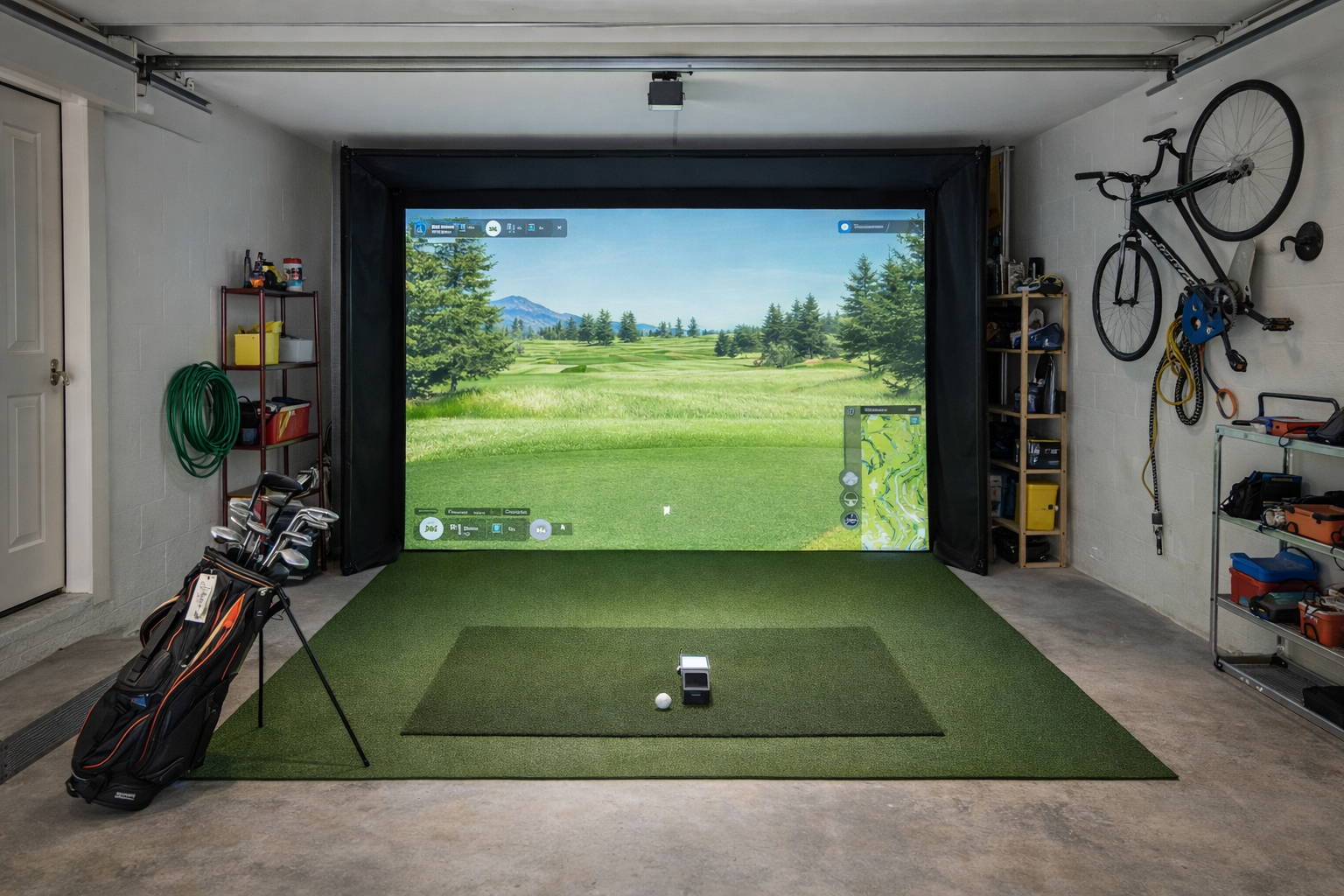
A low ceiling does not automatically kill a home golf simulator, but it changes the whole build. The question is not only whether the club clears once. It is whether you can swing without protecting the ceiling in your head.
Quick answer
- 8-foot ceilings: possible for some golfers and partial bags, but usually not comfortable for driver.
- 9-foot ceilings: workable for many home setups, depending on golfer height, swing, mat thickness, and room feel.
- 10-foot ceilings: a much better target for a full, more natural simulator room.
The real test is swing confidence
If you steer the club, shorten the follow-through, or avoid driver because the room feels close, the simulator will change your swing. That can still be useful for wedges, irons, speed work, or casual practice, but it is not the same as a full-room build.
Low-ceiling setup paths
| Ceiling | Most realistic setup | Likely compromise |
|---|---|---|
| About 8 feet | Net practice, shorter clubs, careful mat choice | Driver may be unrealistic |
| About 9 feet | Many camera-based indoor setups | Tall golfers still need to test driver |
| 10 feet or more | More comfortable full simulator room | Width/depth can still be limiting |
Pick the launch monitor after the ceiling test
Low ceilings often go with smaller rooms, so avoid assuming a radar monitor is the default. A photometric unit near the hitting area can be easier indoors because it does not need the same downrange and behind-ball spacing as many radar setups.
Related low-room guides
8-foot ceiling guide9-foot ceiling guideRoom depth guideSmall-space launch monitors
Where low-ceiling rooms go wrong
- Using a thick mat that steals clearance.
- Forgetting lights, beams, garage-door openers, or ceiling fans.
- Choosing an enclosure that hangs lower than expected.
- Buying for driver when the room is really an iron-practice room.
Bottom line
A low-ceiling simulator can still be worth building, but only if you are honest about the clubs you can swing naturally. When the ceiling is tight, start small, preserve clearance, and choose equipment around the room instead of forcing a full simulator fantasy.
Next room checks
Basement and ceiling-height follow-ups
Basement rooms are usually limited by ceiling height, depth, and projector placement rather than only by budget.
Basement simulator setupLow-ceiling simulator guideRoom depth guide